
Choose the area you’re addressing

Internal (workforce) identity
Identity Governance or Access Management for your internal needs.

Customer identity (CIAM)
To secure all customer interactions while maintaining a modern and intuitive UX.

IAM engineering
Integrate identity with your systems, services, or operational monitoring as needed.
Take a strategic approach to IAM
Why successful financial institutions rely on IAM
For banks, insurers, investment firms and fintechs alike, cybersecurity is a strategic priority. They operate in an exceptionally complex environment where identity forms the operational backbone of security. A modern IAM solution ensures reliable, controlled access management that remains convenient for both employees and customers.
Operate dozens to hundreds of information systems.
Handle highly sensitive personal and financial data.
Function under strict regulation and oversight.
Are among the most frequent targets of cyberattacks.
Maintain a diverse ecosystem of vendors and external partners.
Demand high service quality and availability.
Require absolutely reliable user authentication.
Security and compliance
IAM helps maintain control over access, audit trails, and compliance with regulatory requirements.
Operational efficiency
Automation reduces operational workload, error rates, and reliance on manual intervention.
Framework for service development
A well-designed ID strategy supports new digital services, integration, and the organization’s continued growth.
Internal (workforce) identity
Identity governance
IDM/IGA ensures that back-office staff, branch employees, suppliers, external partners and even AI agents have precisely the access they need to perform their roles – and nothing more. Automatically, reliably, and in real time.
Immediate productivity
New employees receive the access they need on day one (ideally automated based on role), without waiting for manual IT intervention.
Centralized management
Unified identity management across AD, LDAP and other systems simplifies administration, reduces errors and standardizes processes.
Clear accountability
It is always clear who approves and who owns access and roles. Responsibilities are transparent and traceable across teams and systems.
User efficiency
A self-service portal enables rapid access requests and renewals without unnecessary IT interaction, supported by approval workflows and request status visibility.
Secure collaboration
Contractors, vendors and technical accounts operate under clearly defined rules, with limited privileges and time-bound access – keeping sensitive data under control.
Audit and compliance
A complete audit trail: who accessed what, when, why and on what basis. Easier preparation for internal and external audits, with demonstrable regulatory compliance.
Cost optimization
More precise entitlement and role management helps optimize licences and accounts – you only pay for what is actually used and can quickly decommission inactive access.
Privileged identity management (PIM)
Privileged accounts are governed and monitored (approvals, time-bound elevation, audit trails), significantly reducing the risk of misuse or lateral movement by attackers.
Risk minimization
Access is granted only to systems genuinely required for a role (principle of least privilege). Regular recertification and access reviews maintain compliance and prevent privilege creep.
–> More about Identity Management
Access Management and Single Sign-on
Centralized access management with Single Sign-On (SSO) and identity federation allows users to log in once and gain access to all required systems, including SaaS applications. Financial institutions can thus combine strong security with an excellent user experience, without compromise.
Unified authentication standards
Centralized authentication policies ensure consistent security across all applications, from on-premise systems to cloud services.
Convenient user login
Adaptive MFA and passwordless methods simplify access to systems, and thanks to SSO, users don’t have to remember a large number of passwords.
Compliance and audit
Centralized auditing and logging of all login and access events, integrated with SIEM systems, provide full traceability and evidence for compliance.
Centralized account management
A central repository of authorization data – LDAP/MS AD – enables a standardized technical approach to access sharing.
Account protection
SSO and advanced authentication reduce the number of credentials users must manage, thereby limiting exposure to phishing and data breaches.
–> More about Access Management & SSO
Customer identity (CIAM)
CIAM – Managing your customers’ identities and access
In the digital financial world, a unified identity platform forms the foundation for securing all customer interactions while maintaining a modern and intuitive user experience. It enables the integration of all customer processes into a single governed framework for efficient security, compliance and scalability to millions of digital users.
Secure authentication and account protection
Support for modern methods (FIDO2/WebAuthn, biometrics) and risk-based adaptive MFA reduces fraud, protects accounts and improves login success rates without unnecessary friction.
Transaction confirmation and SCA
For sensitive operations such as payments, limit changes or adding new beneficiaries, strong and step-up authentication is available with a full audit trail. Regulatory requirements are met while maintaining a simple UX.
Onboarding with KYC/AML integration
KYC processes (identity verification, document checks, screening) are embedded directly into registration, accelerating customer activation and improving conversion rates. Different assurance levels can be applied based on product and risk.
Self-service and consent management
A portal for managing personal data, preferences and consents (GDPR/consent). Fewer support requests, greater transparency for customers, and improved data quality.
Consistent cross-channel experience
The same identity and access policies apply across mobile apps, online banking, investments, insurance and ancillary services. Customers enjoy a seamless experience while institutions maintain unified control.
Secure and seamless customer experience
Customers primarily perceive how easily they can register, log in, confirm sensitive operations, or manage their data and consents. A well-designed CIAM solution connects high-level security with a smooth and intuitive digital experience.
What CIAM delivers behind the scenes
A high-quality customer experience relies on an architecture that keeps identity consistent, integrated and controlled across systems and channels. CIAM provides a reliable foundation for identity management, auditing, service integration and long-term control over data and security.
Authoritative source of identity
A single, trusted customer profile acts as the central source of truth for identity attributes, verification status and relationships, reducing duplication and errors.
API and standards-based integration
Integration interfaces connect core systems, CRM, anti-fraud, KYC, call centers and data platforms, accelerating projects and simplifying ecosystem expansion.
Bank identity, eWallet and partner ecosystem
Integration with Bank iD and other trusted identity schemes enables fast and secure verification. Support for eWallets and partners unlocks new services without complex development.
Monitoring, audit and compliance
A complete audit trail: who, when, why and on what basis – covering logins, consents, profile changes and transaction steps. Integration with SIEM ensures centralized oversight.
Control over data and architecture (on-premise)
Identity data remains under your control, without dependency on external services – ideal for sensitive environments, governance and long-term digital strategy.
IAM engineering
Connecting identity with systems, services and monitoring
Translating an identity strategy into a concrete technical architecture and integrating it meaningfully across enterprise and customer systems is a complex task. Our team delivers not only tools but also the design and implementation of the technical layer underpinning identity management. The goal is to create a unified, well-governed ecosystem where identity operates securely, consistently and at scale – with a strong focus on usability, operational stability, monitoring and full traceability of key events.
Identity integration
Legacy system integration
Loyalty programs and discount portals
Alternative payment methods
Monitoring and observability
Identity integration
A robust IAM solution starts with well-designed authentication and authorization flows, integration layers, and operational dependencies, including application and token-mediating back ends. In financial environments, the solution must meet stringent requirements for availability, auditability and compatibility with existing systems. IAM must reliably connect core systems, customer applications, APIs and security tools into a single controlled framework.
Legacy system integration
Financial institutions often run critical applications without support for modern standards and interfaces. IAM must therefore integrate legacy systems using connectors, database links, file interfaces or custom integration layers. An identity gateway bridges the gap between legacy applications and modern identity environments, allowing even older systems to participate in centralized identity, audit and monitoring frameworks.
Loyalty programs and discount portals
Well-managed customer identity creates opportunities for additional digital services that strengthen customer relationships and support business objectives. Modern loyalty programs, discount portals and rewards applications rely on effective identity management. This is not just a marketing matter; it is about securely linking identity, the account, transactions and the individual user.
This includes managing consents, benefits and their usage, integrating external partners and embedding everything into the broader service ecosystem. It enables, for example, real-time evaluation of benefits based on banking transactions, cashback and voucher management, segmentation and personalization, tracking used and unused benefits, and sending relevant alerts and push notifications – bridging the online and physical worlds into a single consistent customer experience.
Alternative payment methods (e.g. CVAK)
Integrating alternative payment methods into a bank’s ecosystem requires a technical layer that securely connects them with existing systems, data and user identity without disrupting operations.
Solutions may include integration with services such as CVAK, as well as internal credit or benefit-based payment mechanisms. The foundation is always a controlled linkage between payment logic, identity and transaction context.
Monitoring and observability
In complex financial environments with high demands on both security and availability, full visibility into system activity is essential. All our solutions therefore provide comprehensive observability – logs, metrics, traces and audit records.
We ensure integration with central logging systems, monitoring platforms, data warehouses and SIEM solutions, whether on-premise or cloud-based. Where needed, we can also deliver standalone observability solutions to enhance operational, security and compliance oversight.
Identity integration
A robust IAM solution starts with well-designed authentication and authorization flows, integration layers, and operational dependencies, including application and token-mediating back ends. In financial environments, the solution must meet stringent requirements for availability, auditability and compatibility with existing systems. IAM must reliably connect core systems, customer applications, APIs and security tools into a single controlled framework.
Legacy system integration
Financial institutions often run critical applications without support for modern standards and interfaces. IAM must therefore integrate legacy systems using connectors, database links, file interfaces or custom integration layers. An identity gateway bridges the gap between legacy applications and modern identity environments, allowing even older systems to participate in centralized identity, audit and monitoring frameworks.
Loyalty programs and discount portals
Well-managed customer identity creates opportunities for additional digital services that strengthen customer relationships and support business objectives. Modern loyalty programs, discount portals and rewards applications rely on effective identity management. This is not just a marketing matter; it is about securely linking identity, the account, transactions and the individual user.
This includes managing consents, benefits and their usage, integrating external partners and embedding everything into the broader service ecosystem. It enables, for example, real-time evaluation of benefits based on banking transactions, cashback and voucher management, segmentation and personalization, tracking used and unused benefits, and sending relevant alerts and push notifications – bridging the online and physical worlds into a single consistent customer experience.
Alternative payment methods (e.g. CVAK)
Integrating alternative payment methods into a bank’s ecosystem requires a technical layer that securely connects them with existing systems, data and user identity without disrupting operations.
Solutions may include integration with services such as CVAK, as well as internal credit or benefit-based payment mechanisms. The foundation is always a controlled linkage between payment logic, identity and transaction context.
Monitoring and observability
In complex financial environments with high demands on both security and availability, full visibility into system activity is essential. All our solutions therefore provide comprehensive observability – logs, metrics, traces and audit records.
We ensure integration with central logging systems, monitoring platforms, data warehouses and SIEM solutions, whether on-premise or cloud-based. Where needed, we can also deliver standalone observability solutions to enhance operational, security and compliance oversight.
Compliance
IAM as a common denominator for financial regulations
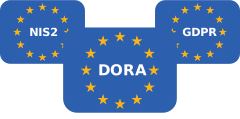
Identity and access management helps financial institutions meet regulatory requirements systematically, sustainably and with reduced operational burden.
DORA
Centralized identity and access management ensures control over permissions to critical ICT systems, including those of external entities and technical accounts. Access rights can be restricted or revoked in real time – crucial for incident response and operational resilience.
PSD2/3
Clear user identity, strong authentication and precisely defined permissions form the basis of secure access to payment services. Identity-based access control separates roles of customers, employees and third parties across channels.
GDPR
Role- and responsibility-based access ensures personal data is available only to authorized individuals and only for as long as necessary. Automated identity lifecycle management supports timely deprovisioning and data protection requirements.
NIS2
Systematic identity and access management is a fundamental security measure for protecting information systems. Traceability and audit trails support organization-wide cyber risk management.
AML / CFT
Linking permissions to specific identities and roles enables segregation of duties in sensitive processes. Every step is traceable to a responsible individual, supporting transparency and control in financial crime prevention.
National supervision and audit
The current state of identities and access is centrally available without reconstructing data from disparate systems. Audit and compliance reports can be generated directly from IAM at any point in time.
Our approach and projects
Building blocks of an IAM system in the financial sector
A successful IAM solution is the result of a well-designed system that respects the regulatory framework, internal processes, and the operational realities of a financial institution. It is based on a thorough analysis of requirements, the system environment, integration points, workflows, and security needs. Financial institutions typically have clearly defined rules and processes, and the goal is therefore not to disrupt them, but to design an IAM solution that adapts to them, preserves best practices, and simultaneously increases efficiency and security. This is how we approach all our projects, whether it involves a specific integration task or a robust solution for the entire IAM architecture.
At the same time, IAM cannot be a static project. It must function as a living system capable of responding to changing regulations, the development of digital services, and growing client expectations; it must grow alongside the organization while simultaneously supporting its stability, security, and long-term operational sustainability. That is why we do not just create one-off solutions with our clients, but long-term partnerships that typically last more than 10 years.
Customer success stories
–> More customer success stories
Contact