
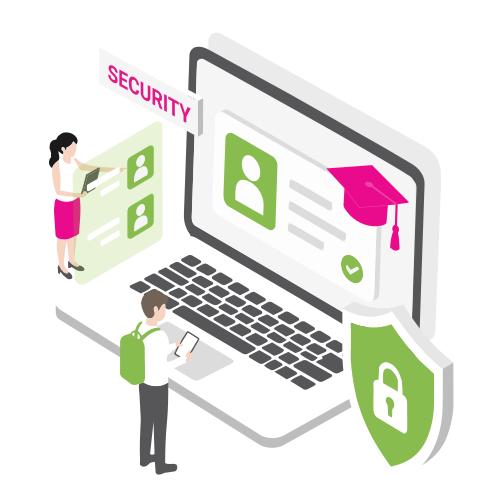
Identity management in educational institutions
A dynamic school environment
Educational institutions operate in a highly dynamic environment, managing large numbers of identities – from hundreds of users at smaller schools to tens of thousands at universities.
The unique environment of schools requires a clearly managed identity lifecycle, secure temporary access, and consistent protection of both personal and school data.
Multiple roles
Student, teacher, external collaborator or guest, with frequent changes to permissions over time.
Access adjustments
Enrollment peaks
Controlled termination
Sometimes with immediate removal of access, and at other times with managed restriction or retention of selected permissions or pseudonymization.
Practical benefits of IDM/IGA
Less manual processing, fewer errors, greater control
IDM/IGA helps educational institutions unify identity governance across school systems and automatically manage access according to role, study status or employment status. This enables you to handle enrollment, semester changes and user departures with less administrative effort and a higher level of security.
Enrollment peaks without overloading IT
Identities can be created in bulk and access can be assigned automatically.
The right access for every user
IDM reflects the role and status of each student, lecturer, employee, external collaborator or guest.
Fewer errors during semester changes
Temporary and external access under control
Reduced workload for the IT department
Users can reset passwords, manage their profiles and submit access requests themselves, including approval workflows.
Minimized security risks when users leave
Permissions are removed automatically while traceability is preserved, including support for grace periods and pseudonymization.
Compliance
Regulatory compliance without unnecessary burden
Educational institutions process large volumes of personal data relating to students and employees, and are often also subject to requirements for a defined level of cybersecurity. IDM/IGA helps meet the requirements of GDPR and, for selected organizations, obligations arising from NIS2.
IDM/IGA handles often-overlooked processes such as data shredding, which are required by GDPR. Pseudonymization options allow data restoration (e.g. for students enrolling in consecutive programs or employees returning after just one semester off) while maintaining privacy.
The system enforces identity and access management requirements in line with the latest legislation. Legal changes usually require simple reconfiguration. IDM also generates detailed access reports for audit readiness.
IDM serves as the backbone for implementing eIDAS processes – automating qualified certificate distribution from providers to target systems.
GDPR
IDM/IGA handles often-overlooked processes such as data shredding, which are required by GDPR. Pseudonymization options allow data restoration (e.g. for students enrolling in consecutive programs or employees returning after just one semester off) while maintaining privacy.
NIS2
The system enforces identity and access management requirements in line with the latest legislation. Legal changes usually require simple reconfiguration. IDM also generates detailed access reports for audit readiness.
eIDAS (where electronic identification or login is used)
IDM serves as the backbone for implementing eIDAS processes – automating qualified certificate distribution from providers to target systems.
1) Enrollment and onboarding peaks
2) Changes during the semester: courses, groups, projects
3) Guests and external collaborators
4) Offboarding graduates and departing employees
5) Access reviews and audits
6) Self-service password change and reset
Real-world examples
Typical scenarios where IDM/IGA helps with day-to-day operations
A properly configured IDM/IGA reduces the IT team’s manual workload, minimizes permission errors, and ensures that every user has the right access at the right time.
Real-world examples
Typical scenarios where IDM/IGA helps with day-to-day operations
A properly configured IDM/IGA reduces the IT team’s manual workload, minimizes permission errors, and ensures that every user has the right access at the right time.
1) Enrollment and onboarding peaks
BEFORE
Manual creation of accounts and permissions, helpdesk queues and errors in access rights.
AFTER
Bulk identity creation and automatic assignment of permissions based on status and role within seconds.
2) Changes during the semester: courses, groups, projects
BEFORE
Permissions are patched together manually, and old access is often forgotten rather than removed.
AFTER
Permissions change automatically based on updates in source systems — courses, groups, work schedules and project teams.
3) Guests and external collaborators
BEFORE
Shared accounts, unclear ownership of access and no time limits.
AFTER
Temporary identities with expiry, approval and an audit trail; access is granted only for as long as necessary.
4) Offboarding graduates and departing employees
BEFORE
Accounts remain active for a long time, and permissions are removed late or incompletely.
AFTER
Controlled termination: immediate removal of critical permissions, and grace periods or pseudonymization.
5) Access reviews and audits
BEFORE
Information is gathered from multiple systems, supporting materials are incomplete and checks take a long time.
AFTER
Clear reports, access recertification and traceability of changes within a few clicks.
6) Self-service password change and reset
BEFORE
The IT department is overloaded with forgotten-password requests, and the handover of initial passwords is complicated or relies on easily guessable initial passwords.
AFTER
A significant reduction in the workload on the IT department relating to password requests, with secure password setup enabled through integration with trusted identity providers (banking identity, government identity providers).
Architecture
A seamless flow of identities across school systems
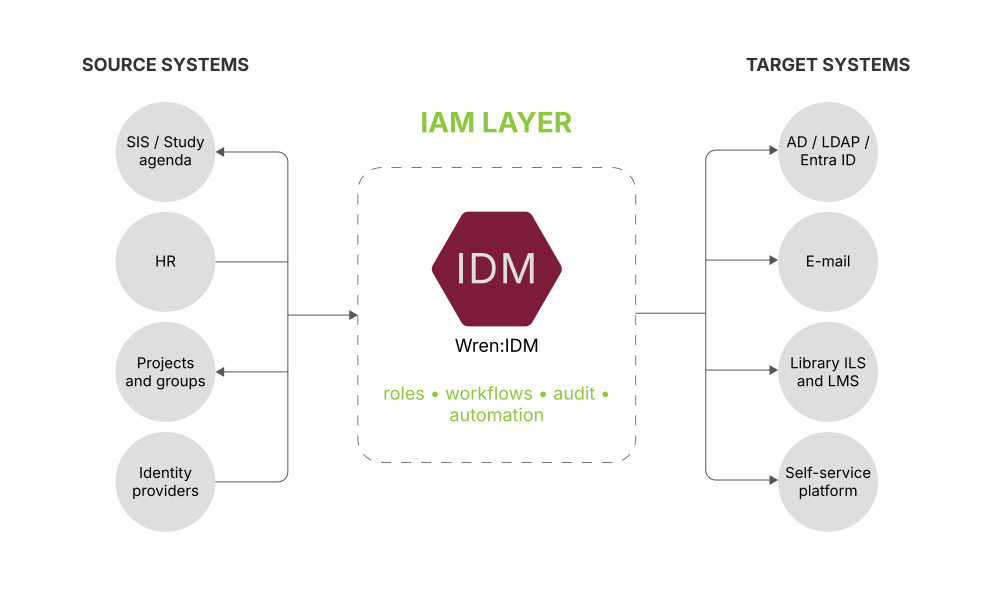
Our IDM/IGA solution is designed from the ground up to reflect the high level of change and the specific characteristics of academic environments. We do not force universities and schools into rigid, ready-made concepts. Instead, we use the flexible open-source Wren:IDM platform and tailor it fully to the institution’s internal processes. The result is a system that naturally connects student information systems, HR systems and operational infrastructure such as Active Directory, email and library systems.
We deliver the solution using DevSecOps and configuration as code principles. This ensures that all configuration is transparent, auditable and easy to transfer between environments.
Measurable benefits
Efficiency reflected in operational metrics
Scalability and automation are at the core of our solution. We can securely handle extreme enrollment peaks, when thousands of identities are created within a short period of time, as well as complex processes linked to graduate departures. We also deliver modern and secure self-service password reset, substantially reducing the administrative burden on IT departments and eliminating the risks associated with weak initial passwords.
80%
in 2 minutes
the user can change their password (the fully self-service process also reduces the IT team’s workload)
thousands
of student accounts created in seconds (peak enrollment periods handled through bulk enrollment)
80–90%
reduction in identity-related incidents and help desk requests
Customer success stories

–> More customer success stories
Contact