
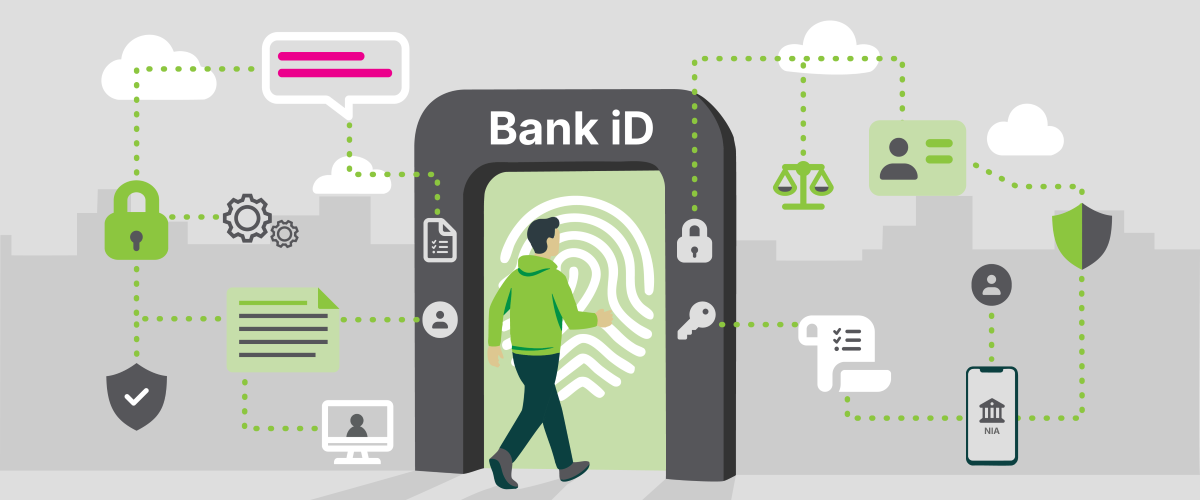
Bank iD: Integrating with the NIA Ecosystem and Exploring its Potential
In our previous article, we explored the National Identity Authority (NIA) – the state-managed system for verifying user identities when accessing digital services. Using the example of the University of South Bohemia, we also demonstrated how connecting NIA, Bank iD, and a university IAM system has simplified and secured the password reset process.
Now, let’s look at the “other half of the story” – Bank iD. What exactly is it, how does it relate to NIA, and when does it make sense to use it?
Bank Identity and Bank iD: A verification method and the commercial counterpart to NIA
Bank identity can be utilised in two fundamental ways: via NIA and via Bank iD.
1. As a means of electronic identification within NIA
Bank identity serves as one of the verification methods when logging into government services through NIA. Public administration bodies and local authorities can use bank identity via NIA free of charge. Other public institutions – such as universities, hospitals, and health insurance companies—can also use it, but they do so under a commercial regime via Bank iD.
Currently, bank identity is the most widely used method for logging into state services. Why is it so popular? Simply because almost everyone with a bank account already has a bank identity. The barrier to entry is minimal – no new passwords, no additional registration; just verification within the familiar and trusted environment of the user’s own bank.
2. The Bank iD commercial identity platform
The same login credentials are also available as a service for private entities and parts of the public sector outside of central government administration. In these instances, verification is not provided by NIA, but by the commercial platform Bank iD (Bankovní identita a.s.).
In this commercial regime:
- Banks act as identity providers.
- Companies and institutions act as service providers.
- Organisations pay for the use of the service.
- Users always enjoy free login and verification.
Why do organisations – including public ones – use Bank iD?
Whether it is a university, a hospital, or a private service, the reasons are similar. Bank iD offers a combination of user convenience and organisational efficiency.
Unrivalled User Reach
Bank identity is now the most frequently used method for logging into state services. By adopting it, organisations gain an access channel that people already know, use, and trust.
Fewer Forgotten Password Issues
If Bank iD is used as the primary login for an organisation’s own system, the user doesn’t need to remember additional credentials. This leads to fewer “I forgot my password” incidents and significantly reduces the load on IT support.
Easier Onboarding for Foreign Users
Foreign students or employees often open a Czech bank account, which automatically grants them a bank identity. Obtaining other NIA-recognised means (like a state-issued eID) would be far more complicated for them.
Enhanced User Experience
Users log in using a method that feels natural to them. This prevents “onboarding friction,” where users abandon a service due to complex registration processes or the need for new accounts.
Simple Integration via OIDC
To the outside world, Bank iD acts as a standardised OpenID Connect (OIDC) provider. This means it integrates in the same way as any other Identity Provider (IdP): typically via the authorization code flow using JWT (JSON Web Tokens).

Practical Applications of Bank Identity
1. Accessing State Services
The most common scenario is logging into the Citizen’s Portal, the Tax Portal, and other government agendas. The user clicks “Bank Identity,” verifies themselves through their bank, and NIA ensures the connection to the state service.
2. AML/KYC and the Financial Sector
Entities with an obligation to identify their clients (Anti-Money Laundering/Know Your Customer) – such as insurance companies, investment platforms, and other regulated organisations – often choose Bank iD as a fast and secure verification method.
3. E-commerce and Age Restrictions
Selling age-restricted goods (e.g., alcohol) requires “18+” verification. Bank iD reliably confirms this detail in real-time without the need for the user to upload ID documents.
4. Universities, Hospitals, and Health Insurance Companies
These institutions are part of the public sector and can use NIA, but they frequently supplement it with Bank iD – primarily for user convenience and the widespread availability of the tool. This is the case at the University of South Bohemia, where Bank iD complements NIA as a convenient and secure way to verify identity during password resets.

NIA and Bank iD: Two paths, one digital identity
From a user’s perspective, the login process looks almost identical every time:
- Choose the method (e.g., bank identity).
- Verify credentials within the bank’s secure environment.
- Return to the service and proceed.
The only difference lies in who mediates the verification:
- For public administration bodies, it is NIA.
- For companies and public institutions outside central government, it is the commercial Bank iD platform.
Ultimately, the user uses the same tool – one digital identity for all services. Simple, secure, and without additional passwords.
Case Study: University of South Bohemia
At the University of South Bohemia, we connected the university’s IAM system with NIA and Bank iD to implement a secure self-service password reset.
As a result, students can:
- Securely set their initial password.
- Reset it themselves at any time using Bank iD or NIA.
The result is a reduced workload for the IT department, increased security, and a significantly improved user experience.