
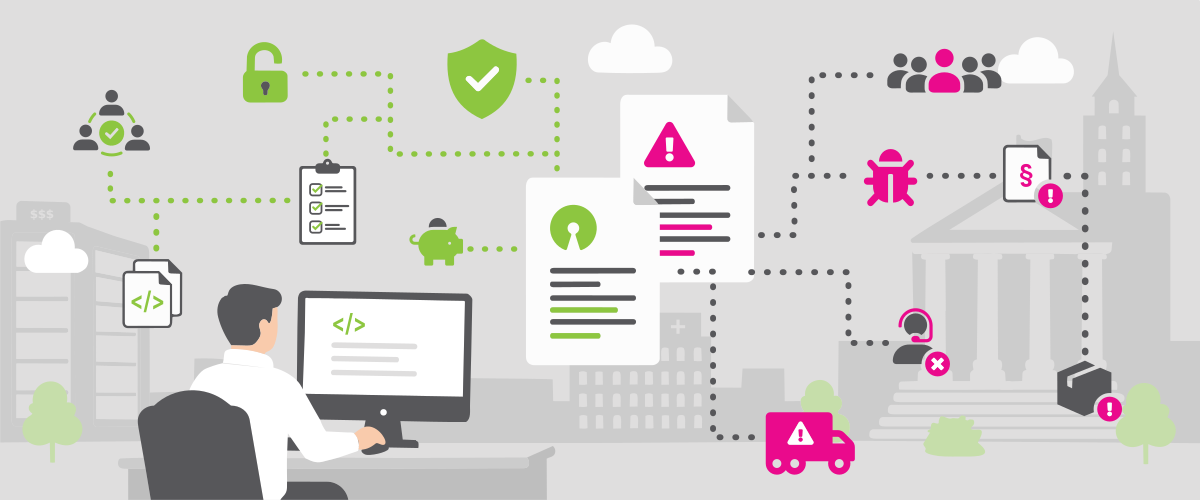
Open source: software that anyone can use, modify and share. Over the past two decades, it has become a major component of enterprise IT. It underpins cloud platforms, security tools and robust identity management (IdM) systems. The idea of open software is so powerful that the European Commission includes it in its strategy as a key instrument for digital sovereignty.
Open code brings enormous freedom, but also a specific kind of responsibility. Let us look at what open source realistically offers in a corporate environment, and what challenges it involves.
Why open source makes strategic sense
Open-source solutions offer benefits that commercial closed-source products struggle to replicate. The key advantages include:
1. Code transparency
Code transparency is not merely a philosophical principle; it is a practical advantage. It helps with security audits, system integration and day-to-day troubleshooting. When a system behaves unexpectedly, your specialists can look directly into the code and find out why. With closed-source solutions, your only option is to open a ticket and wait for the vendor’s response.
2. Robustness and flexibility
Open-source projects are usually designed to cover the broadest possible range of use cases. They are modular and extensible. Thanks to access to the source code, you can tailor the system to your organization’s needs – you are not limited by what the creators of closed software allow or preconfigure.
3. No vendor lock-in
Dependence on a single supplier is a strategic risk. If a commercial vendor changes its licensing policy, increases prices or discontinues the development of a function you critically need, your options are limited. With open source, you have freedom. You can switch support providers, develop the system internally or rely on the community.
4. Security under community scrutiny
Active open-source projects are reviewed by hundreds of developers from different organizations, each approaching the code from a different perspective. Vulnerabilities are identified more quickly than in closed code, which is visible only to the vendor’s internal team.
5. Predictable costs and continuity
You do not pay license fees for the open-source software itself, even as the number of users grows. This gives you significant economic freedom. In addition, the end of support from one partner does not mean the end of system operation. You can continue running the software safely, or move to a community fork, without having to rewrite the entire solution from scratch.
Challenges you need to keep under control
Running open source in an enterprise environment on your own (on-premise) shifts full responsibility for deployment, integration, updates and incident resolution onto your organization. This is not a flaw; it is an architectural decision. But it brings specific challenges:
- Vulnerability management: The average enterprise application today contains hundreds of vulnerable dependencies. Without a clear patch management process, the advantage of transparency can turn into a security risk.
- License compliance: There are dozens of open-source licenses, and combining them within a complex system creates legal exposure that will not go unnoticed during audits. From 2027, the European Cyber Resilience Act will also require a declaration of software components in the form of a Software Bill of Materials (SBOM). Organizations that do not know exactly what they are running today will face problems.
- Knowledge continuity: A system that no one in the team fully understands, or whose knowledge depends on a single person, is a system that will soon become a problem. Knowledge dependency on one colleague is one of the most commonly underestimated operational risks – and a resignation can activate it immediately.
- Missing SLAs: The project community may be willing to help, but it will do so in its own time and on its own terms. For critical systems where every outage has a direct business impact, community support is not enough. There is no guaranteed response time and no clear responsibility for resolving the issue.
- Supply chain attacks: This is a distinct category of risk that does not simply mirror CVE databases. Attackers now inject malicious code directly into open-source packages in repositories – before a vulnerability has even been reported. A passive approach of “we fix what the community reports” is not sufficient for this threat.
What is the way forward?
Running and maintaining a system in-house consumes time that your IT team could otherwise devote to development and improvement. This hidden cost can have a much greater impact on total cost of ownership (TCO) than any license fees.
An effective way to retain the freedom of open source while eliminating operational risks is commercial support. In the next article, we will look at what enterprise support actually involves and what specific guarantees it can provide.
Interested in combining the flexibility of open source with the certainty required for enterprise operations? Follow our blog, or get in touch with us directly – we would be happy to discuss your needs.